

Beyond ERP: How SAP BTP Turns Your SAP Landscape into a Platform
Every enterprise leader recognizes the value of their SAP investment. Years of effort have gone into building a solid ERP or S/4HANA foundation, one that handles the ledgers, procurement cycles, production runs, and tax localizations that keep the business running. It is the digital core.
But look closely at how teams work day to day, and you notice something interesting. Spreadsheets fill the gaps where standard reports fall short. External tools step in where the SAP GUI is not the right fit. Emails and phone calls bridge the steps that the ERP was never designed to cover.
This is not a failure of the ERP. It simply reflects what an ERP is built to do. It handles 90% of the work exceptionally well. But that remaining 10%, often where your business differentiators live, tends to sit outside the system.
This raises a question worth exploring: what if your SAP system could go beyond being a system of record and become a platform, one that your teams can build on, extend, and innovate with?
For decades, the prevailing approach in the SAP world was straightforward: if it involves SAP data, build it inside the ERP. This made sense at the time. Centralization was the priority, and SAP was the natural home for anything business critical. Over the years, this led to highly tailored systems with custom Z programs, modified standard code, and process specific enhancements that reflected each organization’s unique way of working.
The tradeoff, however, became apparent over time. The more customized a system grew, the harder it became to upgrade. Changes in one area could have unintended effects elsewhere, and keeping pace with SAP’s innovation roadmap required increasingly careful planning.
Platform thinking offers a different approach. The ERP remains the Clean Core, stable, standardized, and regularly updated, while everything that makes your company unique is built around it rather than inside it.
Think of the smartphone in your pocket. Out of the box, it has a core operating system that handles the essentials: calls, security, basic settings. It is stable and updated regularly by the manufacturer. But the reason your phone is indispensable is not the dialer app. It is the ecosystem built on top of it. You do not rewrite the operating system every time you need a new banking tool or a weather app. You use the platform to extend its value.
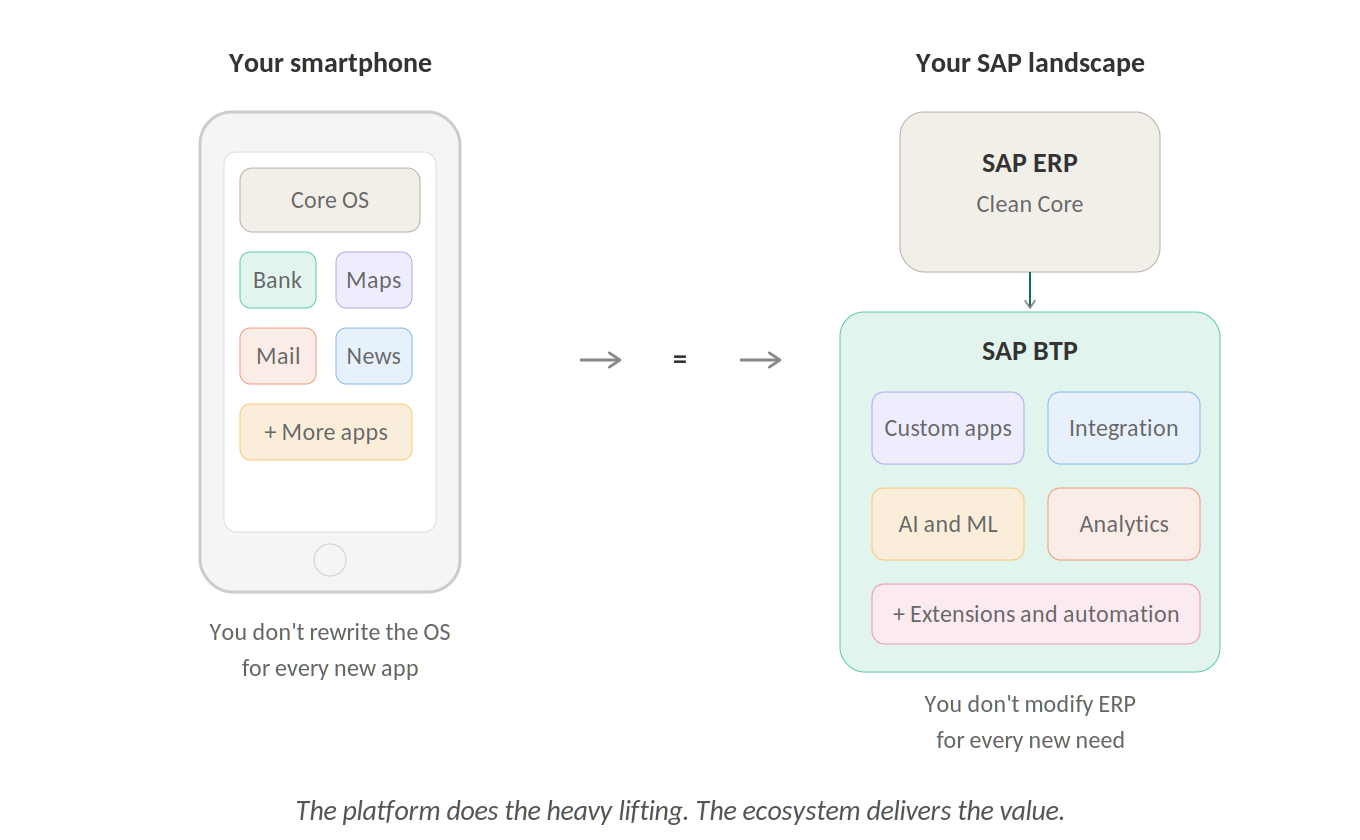
SAP Business Technology Platform is that ecosystem layer for your business. It lets you treat your ERP not as a static system to be modified, but as a foundation to build on, extending its reach while keeping the core intact and future ready.
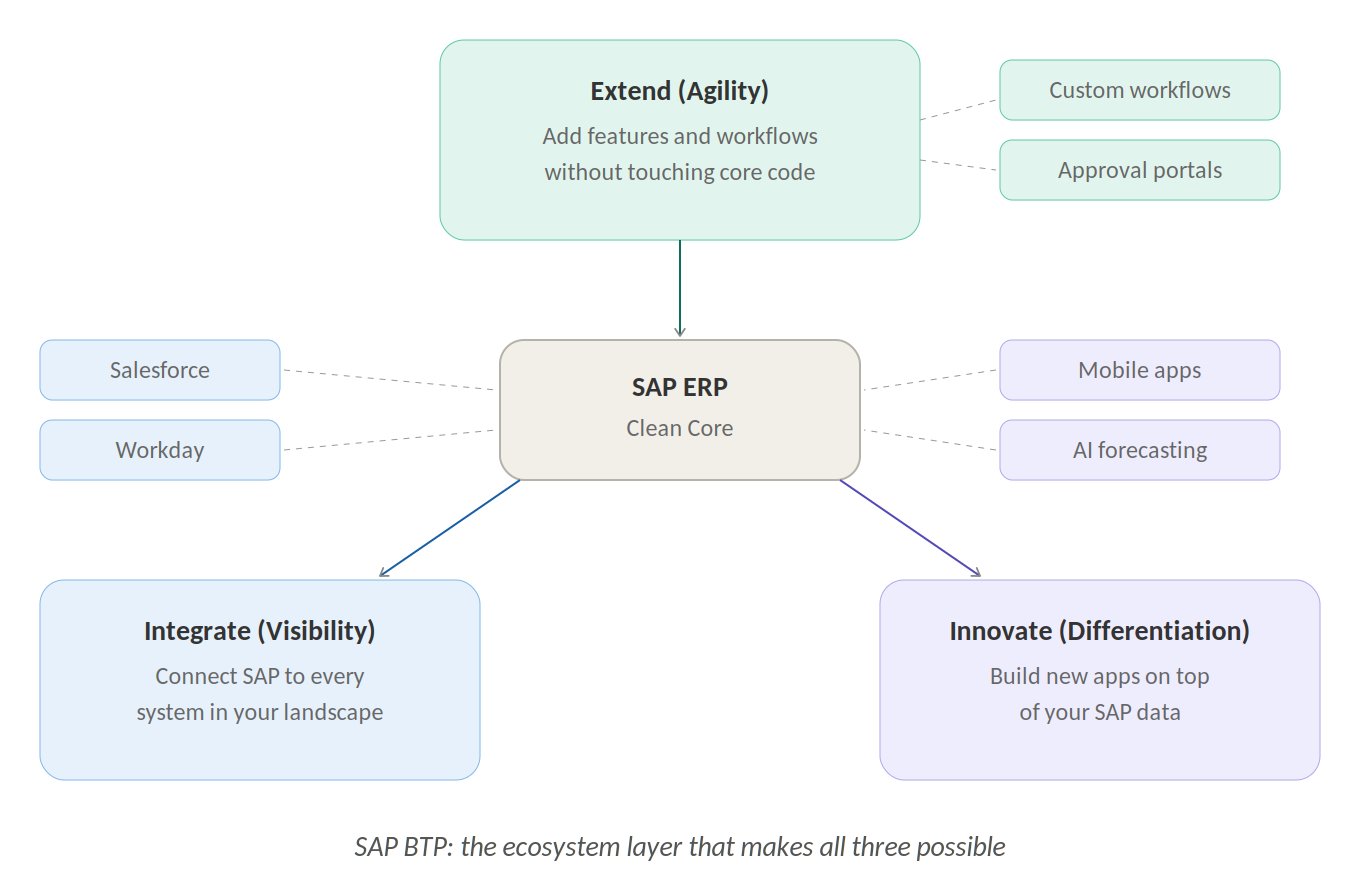
If you look at an SAP product catalogue, BTP can look like a list of technical services: databases, runtimes, AI tools, and integration adapters. For a business leader or decision maker, however, BTP is best understood not as a product list, but through three core strategic capabilities.
1. The Ability to Extend (Agility)
This is about side by side extensibility. It means you can add new features, custom business logic, or unique workflows to your SAP environment without actually touching the core code of your ERP. Because the custom logic lives on BTP and talks to SAP via secure APIs, your core remains clean. When it is time to upgrade your S/4HANA system, you do not have to spend months retesting your customizations. They just work.
2. The Ability to Integrate (Visibility)
Modern businesses do not run on SAP alone. You likely have a CRM like Salesforce, a specialized HR tool like Workday, third party logistics providers, and perhaps a legacy system in a remote warehouse. BTP acts as the universal translator. It seamlessly connects SAP to everything else, ensuring that data flows in real time across your entire landscape. No more data silos where the warehouse thinks there is stock but the sales team sees an empty shelf.
3. The Ability to Innovate (Differentiation)
This is where you build entirely new applications that give you a competitive edge. These are apps that use your rich SAP data but offer a modern, intuitive experience. Whether it is a mobile app for field technicians, an AI driven demand forecasting tool, or an automated invoice processing bot, BTP provides the tools to build these on top of your data faster than ever before.
Why is the platform conversation gaining so much momentum right now? It is not just a trend. It is driven by four major shifts that are hitting enterprises at the same time.
The S/4HANA Transition. As companies move toward S/4HANA Cloud, the old ways of heavy customization are technically disappearing. Cloud environments require and enforce a Clean Core. If you want custom features in a cloud first world, you need to build them on a platform like BTP.
The Pace of AI and Automation. We are in the midst of an AI revolution. However, running experimental AI models directly inside your core financial system is not ideal. BTP provides a space where AI can interact with SAP data safely, allowing you to automate routine tasks without risking the integrity of your general ledger.
User Expectations. In 2026, your employees expect consumer grade experiences. They want to approve a purchase order on their phone while waiting for a flight, not navigate through a series of complex SAP GUI screens.
Business Resiliency. The last few years have taught us that supply chains and markets can change overnight. A platform approach allows you to pivot your processes in weeks, rather than the months or years a traditional ERP change would require.
Skipping a platform approach isn’t neutral, it’s a choice to accumulate technical debt. Without a strategy, you will eventually hit an “Upgrade Wall” where further progress becomes impossible.
Every custom modification made inside your ERP is a hook that attaches your business process to a specific version of the software. Over time these hooks accumulate until the system is so customized that it is effectively frozen in time. The cost to move to the next version becomes so high that the business decides to stay on the old version, slowly losing access to new security features, better performance, and modern innovations like AI.
On top of that, without BTP, you often end up with integration spaghetti. Point to point integrations between dozens of systems eventually become difficult to manage. When one system is updated, the whole web is at risk. BTP centralizes this, turning fragmented connections into a clean, managed hub architecture.
To make this tangible, here is how this shift can change a typical workday.
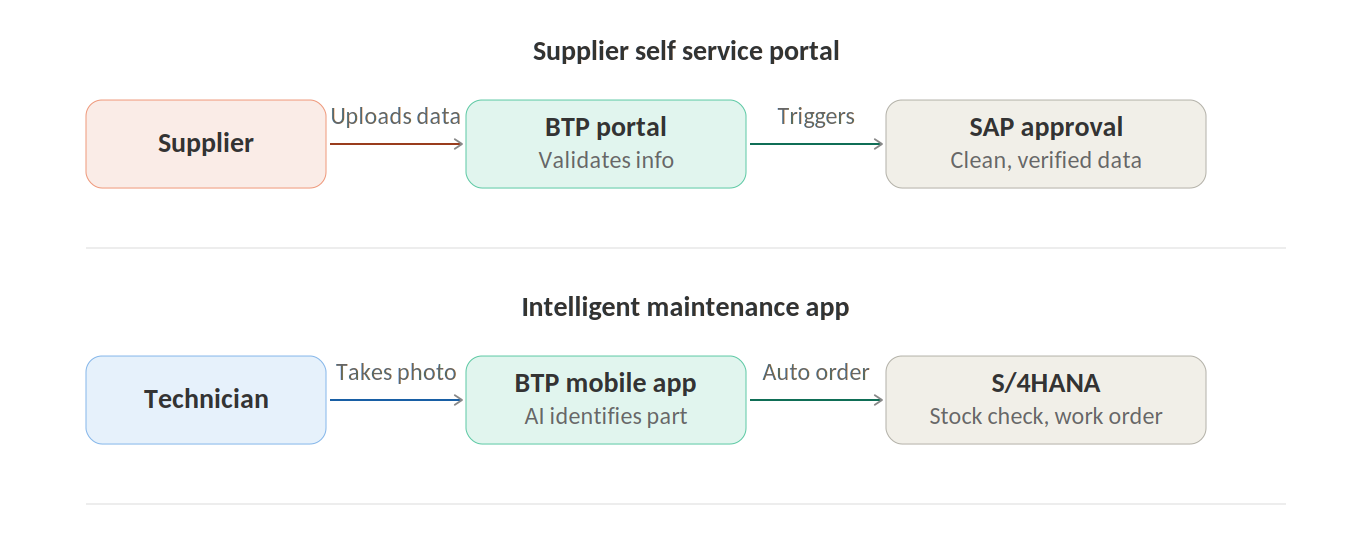
Scenario A: The Supplier Self Service Portal
In a traditional setup, onboarding a new vendor involves dozens of emails, manual data entry into SAP by a busy procurement clerk, and a high risk of errors. With a platform approach, you build a lightweight portal on BTP. The supplier logs in, uploads their own certifications and banking details, and the system automatically validates their information. Once everything checks out, it triggers a workflow in SAP for final approval. The data is accurate, the clerk saves hours of work, and the supplier has a better experience.
Scenario B: The Intelligent Maintenance App
A field technician needs to repair a pump in a remote facility. Traditionally, they would print out a work order, take photos on a personal phone, and type up a report back at the office days later. With BTP, the technician uses a mobile app that pulls the pump’s service history directly from S/4HANA. They take a photo, and AI on BTP identifies the specific part that needs attention, checks the warehouse for stock in real time, and creates the follow up order instantly.
The role of ERP in the enterprise is evolving. Organizations that embrace platform thinking, building around a stable core rather than endlessly customizing within it, will be better positioned to adapt, innovate, and grow in the years ahead.
But understanding the “why” is only the beginning. The real value comes from understanding the “how.” Over the coming posts in this series, we will go deeper into the building blocks of SAP BTP and explore how each one unlocks new possibilities for your business.
Insight into SAP BTP Architecture and Services — A clear look at how BTP is structured, what services are available, and how they fit together to support your SAP landscape.
Application Development and Automation — How to build modern, user-friendly applications and automate repetitive processes without modifying your ERP core.
Integration Capabilities — Connecting SAP with third party systems, cloud services, and legacy applications to create a seamless flow of data across the enterprise.
Data and Analytics — Turning your SAP data into real time insights that drive better decisions, from the boardroom to the shop floor.
Artificial Intelligence in SAP BTP — Practical ways to bring AI into your SAP processes, from intelligent automation to predictive analytics, without building from scratch.
Sustainability in the Cloud — How BTP supports your sustainability goals through better resource tracking, carbon footprint visibility, and green cloud infrastructure.
The journey from a system centric to a platform centric SAP landscape does not happen overnight. It takes a clear roadmap, the right architecture decisions, and a partner who understands both the technology and the business reality behind it.
At Intellect Consulting, we understand both the technology and the business behind it. We help organizations put the right architecture in place so your BTP investment delivers real value from day one.
Follow along with this series, and when you are ready to talk, we are just a conversation away.